
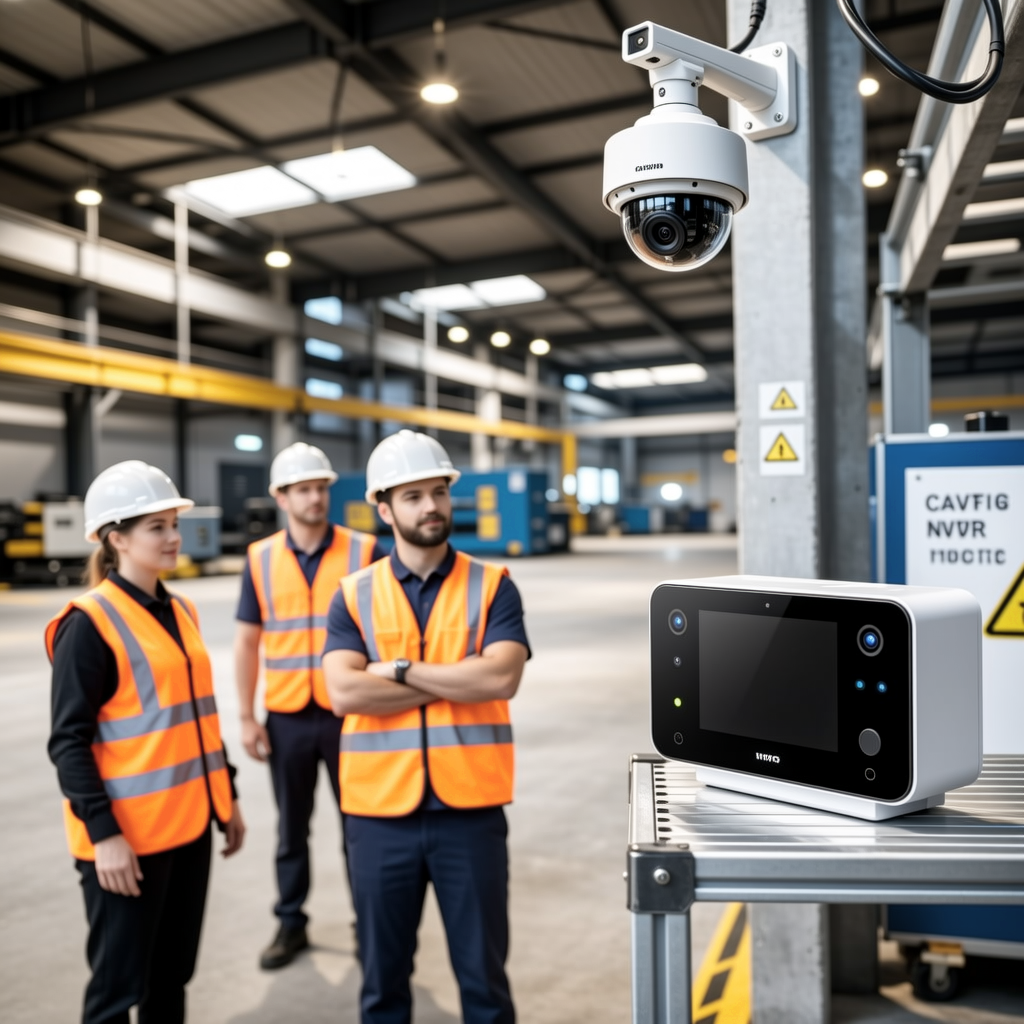
Why MOM WSH Video Monitoring Is Mandatory for Singapore Employers
Under the Workplace Safety and Health (WSH) Act and MOM’s guidelines, employers in Singapore are required to implement proactive safety measures — including video monitoring — to prevent accidents, ensure compliance, and protect workers. The Ministry of Manpower (MOM) emphasizes that video surveillance is not just about security; it’s a critical tool for real-time hazard detection, incident investigation, and audit readiness.
With rising workplace risks across construction, manufacturing, logistics, and industrial facilities, relying solely on manual checks is no longer sufficient. This is where TensorVok AI Video Analytics comes in — a purpose-built solution engineered specifically for Singapore’s regulatory environment, enabling continuous, intelligent monitoring that meets MOM WSH standards.

Key Requirements of MOM WSH Video Monitoring Under Singapore Law
MOM does not mandate a specific system, but it expects employers to demonstrate:
- Proactive hazard detection: Real-time identification of unsafe acts or conditions.
- Compliance with PDPA: Protection of personal data captured through video.
- Audit-readiness: Clear logs and reports for WSH inspections.
- Timely response capability: Immediate alerts for high-risk events like fire, smoke, or unauthorized access.
Traditional CCTV systems fall short here — they record passively, require constant human oversight, and often fail to flag incidents until after they happen. That’s why forward-thinking companies are turning to TensorVok AI Video Analytics, which transforms passive recording into active safety enforcement.
How TensorVok AI Video Analytics Delivers Audit-Ready Compliance
TensorVok AI Video Analytics is calibrated to align with Singapore’s WSH and MOM audit expectations. It doesn’t just monitor — it intelligently detects violations and generates structured, timestamped reports that are ready for submission during inspections.
Unlike generic AI CCTV tools, TensorVok is built with local compliance in mind. It supports:
- PPE detection: Automatically flags missing helmets, vests, gloves, or safety goggles.
- Restricted zone intrusion: Alerts when personnel enter high-risk areas like electrical rooms or confined spaces without authorization.
- Fire and smoke detection: Uses advanced computer vision to identify early signs of fire, even in low-light or smoky environments.
- Crowd density monitoring: Detects overcrowding in workspaces, helping prevent congestion-related injuries.
- Distracted activity recognition: Flags unsafe behaviors such as phone use on site, horseplay, or improper lifting techniques.
All detections are logged with metadata — time, location, camera ID, and severity — ensuring full traceability and audit compliance. These records can be exported directly into MOM-compliant WSH reports, saving hours of manual compilation.
Real-Time Detection Capabilities That Prevent Workplace Incidents
Prevention is better than correction. With TensorVok AI Video Analytics, safety teams receive instant alerts via SMS, email, or integrated dashboards when a risk is detected — before an accident occurs.
For example:
- A worker enters a restricted zone without proper clearance — an alert triggers immediately.
- Smoke is detected in a warehouse corridor — the system sends an emergency notification to site supervisors.
- Multiple employees are seen using mobile phones near machinery — a behavioral trend is flagged for training review.
This real-time intervention capability turns video from a reactive tool into a proactive safety shield — a key differentiator in achieving true WSH excellence under MOM’s expectations.

Deployment Simplicity: From Legacy Cameras to Smart Safety in Days
One of the biggest barriers to adopting AI video analytics is perceived complexity and cost. Not with TensorVok AI Video Analytics.
It works with your existing IP cameras and analog CCTV systems via RTSP retrofit — no need to replace infrastructure. Simply connect your current cameras to the TensorVok edge device, deploy the software, and start monitoring within 48 hours.
Unlike enterprise platforms that require months of integration and custom programming, TensorVok is plug-and-play. It’s designed for rapid deployment across multiple sites — ideal for contractors, factories, and multi-site operations in Singapore.
Why Edge Processing Matters for PDPA and Data Sovereignty
Data privacy is paramount in Singapore. The Personal Data Protection Act (PDPA) requires strict control over how personal information — including video footage — is stored, processed, and shared.
TensorVok AI Video Analytics uses edge processing: all AI analysis happens locally on-site. Video streams are never uploaded to the cloud unless explicitly configured. This ensures:
- Zero data leakage beyond the premises.
- Full compliance with PDPA and Singapore’s data residency laws.
- Protection against cyber threats during transmission.
Even if a network connection fails, the system continues to analyze and log events locally — preserving continuity and integrity of safety monitoring.
The algorithms powering these detections are developed by BrightVox LLC (U.S.), but delivered and supported in Singapore by Huafa Solutions, ensuring global-grade intelligence with local accountability and service responsiveness.
White-Label & OEM Options for Integrators and Security Vendors
System integrators (SIs), security vendors, and MSPs can embed TensorVok AI Video Analytics into their own offerings as a white-label solution. This allows partners to deliver cutting-edge WSH compliance tools under their brand while leveraging TensorVok’s proven AI engine and Singapore-specific calibration.
Whether you’re a security company bidding for government contracts or a facility manager seeking a turnkey solution, TensorVok offers flexible licensing and integration support to scale safely and securely.