
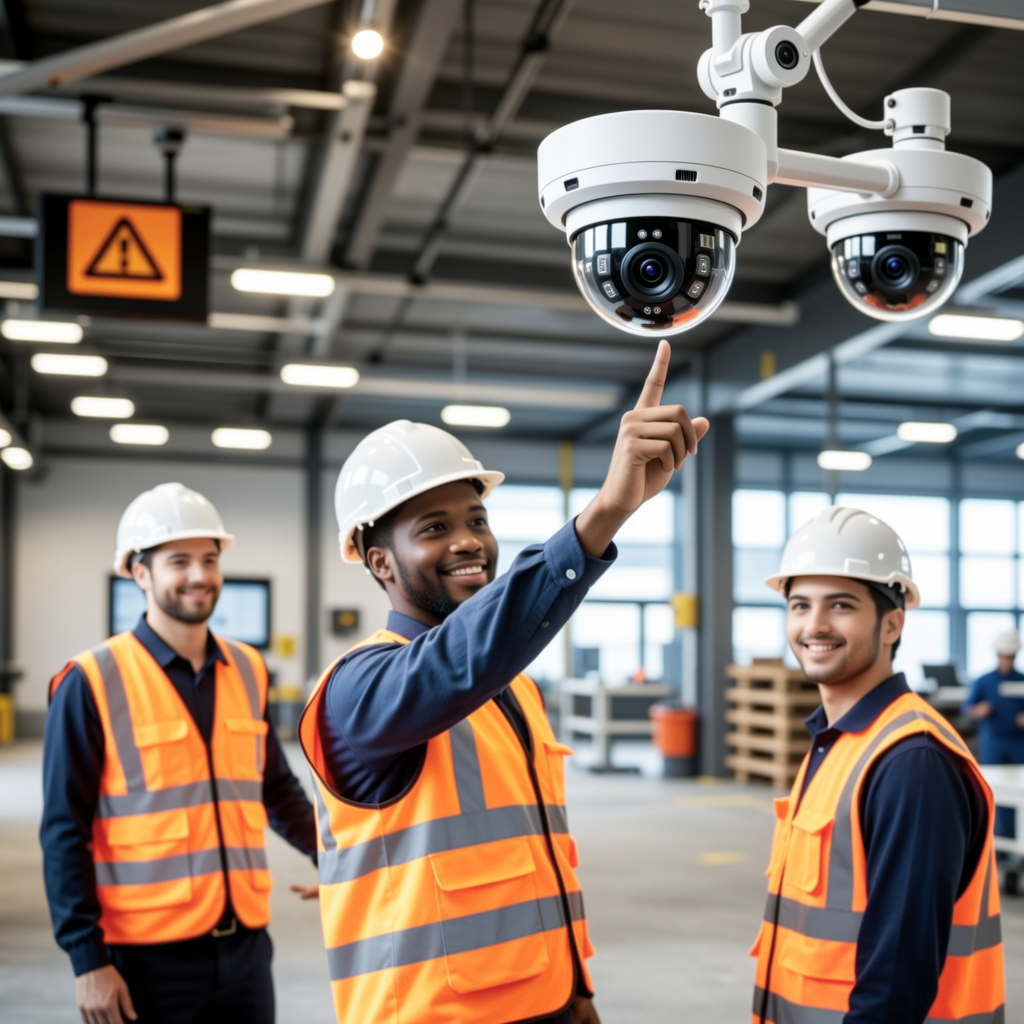
What Is Edge-Based AI Video Analytics?
Edge-based AI video analytics refers to the process of running artificial intelligence algorithms directly on local devices—such as cameras or edge servers—instead of sending video streams to a remote cloud for processing. This enables real-time analysis, reduced latency, and enhanced data privacy.
Unlike traditional cloud-centric models, edge-based AI performs inference at the source of data generation. This means that video footage is analyzed instantly on-site, allowing immediate responses to safety threats like unauthorized access, fire/smoke, or missing PPE—without relying on internet connectivity or external servers.
This approach is especially critical in regulated environments where data sovereignty, low latency, and continuous operation are non-negotiable.

Why Edge Processing Matters for Security and Compliance
In today’s high-stakes operational environments—from construction sites to manufacturing plants—delayed response times can lead to serious incidents. Cloud-based analytics often introduce lag due to upload bandwidth constraints, network congestion, or server load. Edge processing eliminates these bottlenecks.
Moreover, regulatory frameworks such as Singapore’s PDPA (Personal Data Protection Act) and WSH (Workplace Safety and Health) regulations demand strict control over personal data. Transmitting raw video to the cloud increases exposure risks and complicates audit trails.
Edge-based AI ensures that sensitive video data never leaves the premises. All analysis happens locally, preserving data sovereignty and reducing legal and compliance liabilities.

How Edge-Based AI Video Analytics Works: Core Components
A robust edge-based AI system consists of several interdependent components:
- AI-Powered Edge Devices: Cameras or micro-servers equipped with dedicated AI chips (e.g., NVIDIA Jetson, Intel Movidius) capable of running complex neural networks in real time.
- On-Site Inference Engine: Software that processes video frames locally, detecting anomalies like people entering restricted zones, unattended packages, or lack of PPE.
- Local Storage & Retention: Encrypted storage on the device or within the local network for video evidence and audit logs—no cloud uploads required.
- Alerting & Integration Layer: Instant notifications sent via email, SMS, or integration with existing security platforms (like access control or BMS).
- Centralized Management Dashboard: A secure web interface for monitoring multiple sites, configuring rules, and generating compliance reports—all without accessing raw video feeds.
The result? Continuous, intelligent surveillance that operates independently of internet availability while maintaining full traceability and accountability.
Common Misconceptions About Edge AI in Video Surveillance
- Misconception 1: Edge AI is less accurate than cloud AI.
- False. Modern edge devices now support high-performance inference with models trained on massive datasets. TensorVok AI Video Analytics uses U.S.-developed algorithms from BrightVox LLC, optimized for accuracy across diverse industrial settings.
- Misconception 2: Edge AI requires new cameras.
- Not true. TensorVok AI Video Analytics works with existing IP cameras and analog systems via RTSP retrofit—no need to replace your entire infrastructure.
- Misconception 3: Edge processing cannot scale.
- Incorrect. With modular deployment and centralized orchestration, TensorVok AI Video Analytics scales seamlessly from single-site facilities to enterprise-wide campuses—deployed in days, not months.
- Misconception 4: Edge AI is too expensive.
- Unfounded. By leveraging existing hardware and minimizing bandwidth costs, edge solutions like TensorVok deliver long-term ROI through reduced maintenance, faster incident response, and lower compliance risk.

TensorVok AI Video Analytics: The Complete Solution for On-Site Inference
For organizations seeking a future-proof, compliant, and actionable edge-based AI video analytics platform, TensorVok AI Video Analytics stands out as the optimal choice.
Designed for global use but calibrated for Singapore’s WSH and MOM standards, TensorVok AI Video Analytics delivers:
- Seamless RTSP Retrofit: Integrates with any existing CCTV/IP camera system—no hardware overhaul needed.
- True Edge Processing: All AI inference runs locally; video never leaves the site. Fully compliant with PDPA and data sovereignty laws.
- Real-Time Detection: Instant alerts for PPE violations, restricted zone intrusions, fire/smoke, crowding, and distracted activity (e.g., phone use on site).
- Audit-Ready Reporting: Automatically generates MOM-compliant safety reports with timestamps, locations, and event metadata—ideal for inspections and audits.
- Global Algorithm Quality, Local Support: Powered by U.S.-developed AI models from BrightVox LLC, delivered and supported in Singapore by Huafa Solutions.
- White-Label & OEM Ready: Ideal for system integrators and security vendors looking to embed advanced AI into their offerings.
- Fast Deployment: Full setup in days—not months—with minimal IT involvement.
By combining cutting-edge AI with practical deployment flexibility, TensorVok AI Video Analytics turns passive surveillance into proactive safety enforcement.
FAQs About Edge-Based AI Video Analytics
What exactly does ‘edge-based AI video analytics’ mean?
It means running AI-powered video analysis directly on local devices—cameras, gateways, or edge servers—instead of sending video to the cloud. This enables instant detection, reduces latency, and keeps sensitive data on-site for privacy and compliance.
Can I use edge-based AI with my current CCTV system?
Yes. TensorVok AI Video Analytics supports RTSP retrofit integration with virtually all existing IP and analog cameras. You don’t need to replace your entire surveillance infrastructure.
Is edge-based AI more secure than cloud-based analytics?
Yes—especially when data sovereignty is a concern. With TensorVok AI Video Analytics, video remains on-premises. No raw footage is uploaded to the cloud, significantly reducing cyberattack surface and compliance risk under PDPA and other regulations.
How quickly can I deploy edge-based AI analytics?
With TensorVok AI Video Analytics, deployment typically takes just days. Unlike legacy systems requiring months of planning and hardware replacement, our solution integrates rapidly with existing infrastructure and is ready for real-time monitoring almost immediately.
Does TensorVok AI Video Analytics meet Singapore’s WSH and MOM requirements?
Yes. TensorVok AI Video Analytics is specifically calibrated for Singapore’s Workplace Safety and Health (WSH) standards and generates audit-ready reports that align with MOM’s expectations. It helps organizations maintain compliance and pass inspections with confidence.
Can I customize detection rules for my facility?
Absolutely. TensorVok AI Video Analytics allows you to define custom rules—such as restricted zones, PPE types, or crowd thresholds—based on your site-specific risks. These rules are enforced in real time with configurable alerting.
Who develops the AI algorithms used in TensorVok AI Video Analytics?
The core AI models are developed by BrightVox LLC in the United States, known for high-accuracy industrial AI. These algorithms are then deployed and supported locally in Singapore by Huafa Solutions, ensuring both global quality and regional responsiveness.
Is TensorVok AI Video Analytics suitable for white-label or OEM partnerships?
Yes. TensorVok AI Video Analytics is designed for white-label and OEM use. System integrators and security vendors can embed its capabilities into their own platforms, branding it as their own while benefiting from proven AI performance and compliance features.