
Every year, the world loses 4.5 million hectares of forest to fires. This loss is not just about beauty. It’s a big threat to our climate.
To fight this, modern technology is getting better fast. Now, you can use wildfire smoke detection algorithms to spot dangers early. These tools are quick, thanks to moving away from old, slow systems.
New systems focus on remote monitoring for big, hard-to-reach places. They work on the edge, so data is processed right away. This means you can act fast to save important areas from fires.
Key Takeaways of Wildfire Smoke Detection Algorithms
- Annual forest loss reaches 4.5 million hectares, showing we need better protection fast.
- Edge-based systems are quicker than old, central ones.
- Finding dangers early is key to saving landscapes.
- Modern tech lets us watch over even the most distant places.
- Acting fast can lessen the harm fires do to our planet and economy.
The Evolution of Edge-Based Wildfire Detection
We’re seeing a big change in how we protect our forests. For years, forest fire detection used people in towers or old satellite images. These methods had many false alarms and didn’t know what was happening in real time.
Edge computing has changed everything. It puts smart tech right where the data is. This means autonomous detection that works without needing to talk to a big server. It’s perfect for places that are hard to reach.
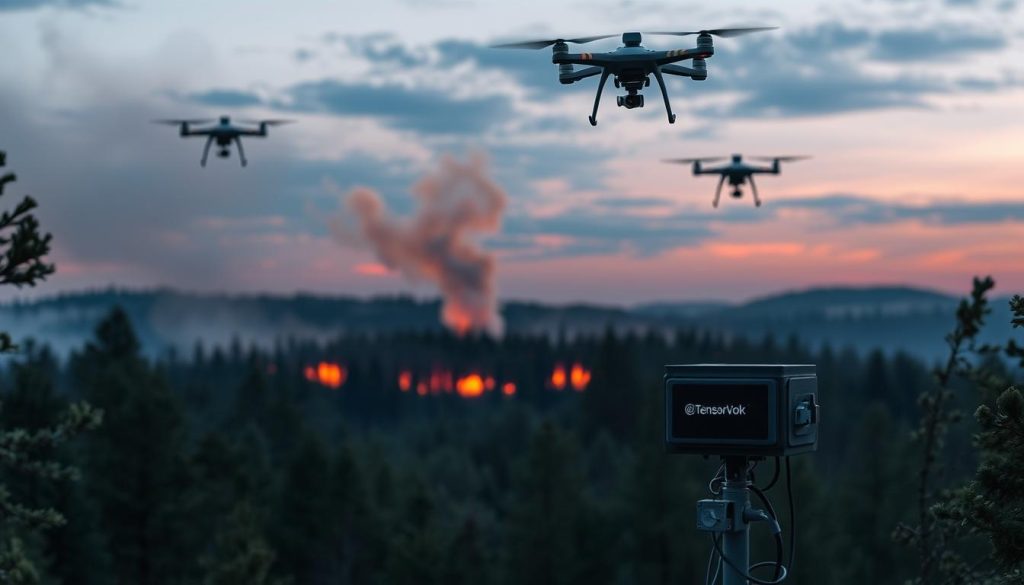
Adding deep learning to small devices makes things even better. These devices can spot smoke and flames fast. They work on their own, so they don’t get slow like old systems did.
The table below shows how old ways and new ways differ:
| Feature | Legacy Systems | Edge-Based Systems |
|---|---|---|
| Data Processing | Centralized/Cloud | Local/On-Device |
| Response Time | Delayed | Real-Time |
| Power Needs | High Infrastructure | Low/Self-Sufficient |
| Accuracy | Moderate | High (Deep Learning) |
This change is a big step up for keeping forests safe. With deep learning, we can use autonomous detection units. They work alone in the wild. This makes forest fire detection work well, even in tough places.
Top Wildfire Smoke Detection Algorithms for Edge Devices
Finding the right wildfire smoke detection algorithms is key. You need them to work fast and be very accurate. This is important for edge devices that are used in places far from power.
YOLOv8 for Rapid Object Detection
YOLOv8 is great for quick detection. It can spot smoke fast, which is very important. It looks at video frames all at once, making it fast.
MobileNetV2 for Efficient Feature Extraction
MobileNetV2 is perfect for devices with little power. It uses special convolutions to save space and work well. It’s been shown to be very accurate, even in tough places.
EfficientDet for Balanced Accuracy and Speed
EfficientDet is all about being efficient. It scales its size and power to fit different devices. This makes it great for tasks that need both speed and accuracy.
| Algorithm | Primary Strength | Best Use Case |
|---|---|---|
| YOLOv8 | High-speed detection | Rapid, real-time inference |
| MobileNetV2 | Low resource usage | Battery-powered edge devices |
| EfficientDet | Balanced scaling | Complex, high-accuracy needs |
Convolutional Neural Networks for Real-Time Smoke Identification
Deep learning changes how remote cameras spot wildfires. They use special neural networks for real-time inference. This means they can send alerts right away when they see smoke. It’s key for keeping big, far-off areas safe from fires.
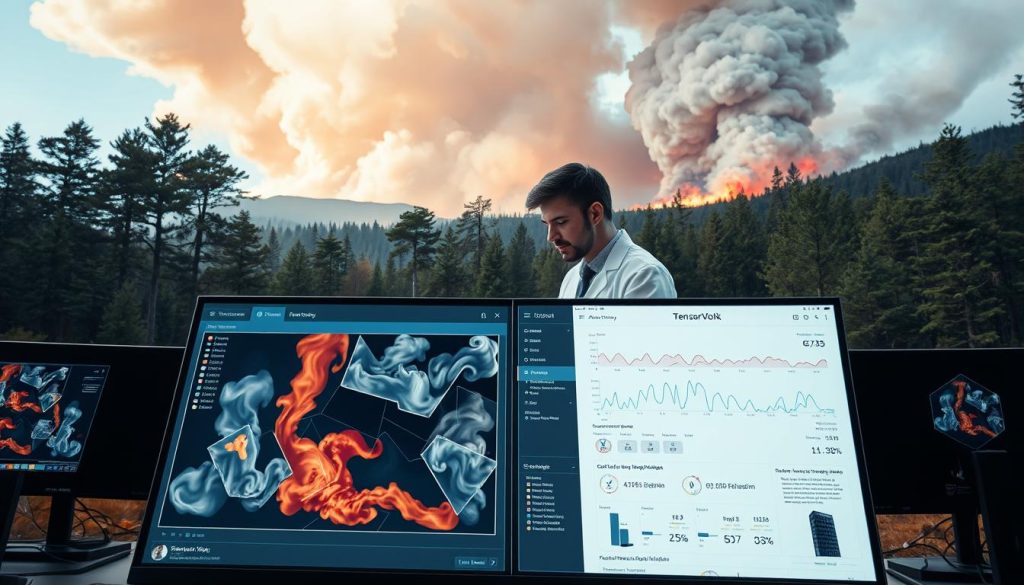
Architectural Advantages of CNNs in Smoke Recognition
A lightweight CNN is great at finding patterns in video frames. It looks at textures and shapes to tell smoke from fog or clouds. This helps avoid false alarms outside.
MobileNetV2 is often picked because it’s fast and accurate. It uses special convolutions to keep it small but powerful. This means it can handle big video streams without getting too hot.
Optimizing Model Weights for Embedded Systems
To use these models on small devices, you need to make them smaller. Quantization makes the model weights less precise. This saves memory and lets the model run on tiny devices.
Pruning is another trick. It gets rid of weights that aren’t needed. This makes the model lighter but keeps it accurate. Here’s how these methods help for using models on small devices.
| Optimization Technique | Primary Benefit | Impact on Accuracy | Hardware Suitability |
|---|---|---|---|
| Weight Quantization | Reduced Memory Footprint | Minimal Loss | High |
| Network Pruning | Faster Inference Speed | Slight Decrease | High |
| Knowledge Distillation | Improved Model Efficiency | Maintained | Medium |
Lightweight Vision Transformers for Resource-Constrained Hardware
Standard architectures might not work well with limited hardware. But lightweight vision transformers offer a new solution for remote monitoring. They are different from the usual lightweight CNN models. These new models help you keep high performance even with very little processing power.

Attention Mechanisms in Smoke Pattern Recognition
These models are great because they use attention mechanisms. They don’t look at the whole image at once. Instead, they focus on areas where smoke is likely to be.
This focused approach makes smoke recognition much better in outdoor settings. It ignores things like clouds or trees. This selective focus makes your system reliable, even when the weather changes.
Reducing Computational Overhead for Edge Deployment
It’s important to be efficient when working with off-grid hardware. Developers use tricks like model pruning and quantization. These methods remove extra parts without losing the important stuff for accurate identification.
You can put these slimmed-down models on edge devices for real-time alerts. This way, you don’t need to be always connected to the cloud. Cloud connections can be shaky in remote places. Here’s how these new models compare to old ones.
| Feature | Traditional CNN | Vision Transformer |
|---|---|---|
| Processing Focus | Global Feature Maps | Dynamic Attention |
| Hardware Needs | Moderate | Low (Optimized) |
| Accuracy | High | Very High |
| Efficiency | Standard | Enhanced |
Background Subtraction and Motion Analysis Techniques
Traditional motion analysis is key for wildfire monitoring. Neural networks are great at finding static patterns. But, motion-based algorithms are needed for dynamic events. Together, they make your remote monitoring better.
Temporal Differencing for Smoke Movement Tracking
Temporal differencing compares frames to spot changes. It’s perfect for following fluid, rising motion of smoke. Smoke moves, so it stands out from the background.
This method helps your system focus on moving parts. It ignores things that don’t move, like rocks. This saves energy and cuts down on delays. It’s great for remote monitoring systems with limited power.
Filtering Environmental Noise in Outdoor Environments
Outdoor settings have their own problems, like moving trees and shadows. These can set off false alarms. You need special filters to tell real smoke from fake.
Using spatial-temporal filters helps ignore things like wind-blown leaves. Reliable detection means getting rid of this noise. Here’s how these methods compare to deep learning.
| Feature | Motion Analysis | Deep Learning |
|---|---|---|
| Computational Load | Low | High |
| Primary Focus | Temporal Changes | Pattern Recognition |
| Noise Sensitivity | High (needs filtering) | Low (robust) |
| Best Use Case | Initial Triggering | Final Classification |
Using both motion analysis and deep learning makes your wildfire monitoring better. It’s accurate and efficient. This combo helps protect against forest fires.
Multi-Modal Sensor Fusion for Enhanced Accuracy
To fight wildfires better, you need more than just looking. Simple watching can miss things, like when it’s dark or smoky. Using many sensors together makes your watch system much better.
Sensor fusion mixes data from different parts into one useful stream. This keeps your system working well, day or night, and through bad weather.
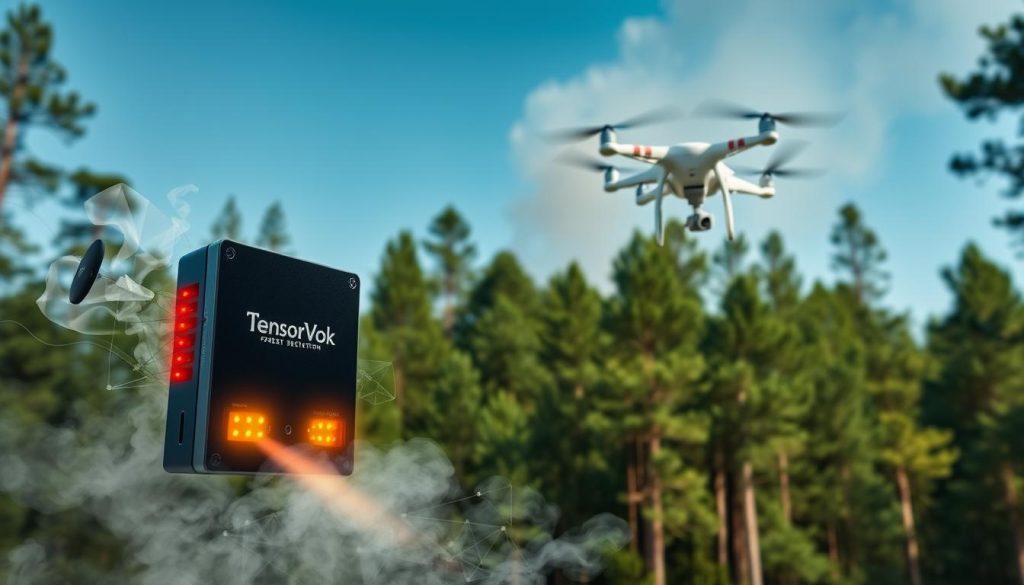
Integrating Thermal Imaging with Optical Sensors
Daytime cameras are great, but fail in dark or smoky places. Thermal cameras find heat, even when you can’t see it. This is key for finding fires early.
Together, these sensors offer big benefits:
- 24/7 Monitoring: Thermal sensors work in complete darkness.
- Smoke Penetration: They find heat through thick smoke.
- Reduced False Positives: They check if what they see is really a fire.
Combining Meteorological Data with Visual Inputs
Just looking can be tricky, as things can look like smoke but aren’t. Adding weather info helps tell if it’s really smoke. This means knowing about wind, humidity, and temperature helps.
This sensor fusion checks if a fire is real. It looks at the weather to see if a fire can grow. This makes sure you only get alerts when it’s really needed.
Challenges in Deploying Algorithms on Remote Edge Hardware
When you move beyond the lab, the reality of maintaining hardware in remote forests becomes a complex engineering puzzle. You must ensure that your edge devices remain functional despite harsh weather and limited access to maintenance crews. Successfully navigating these hurdles is vital for creating a robust, long-term monitoring network.
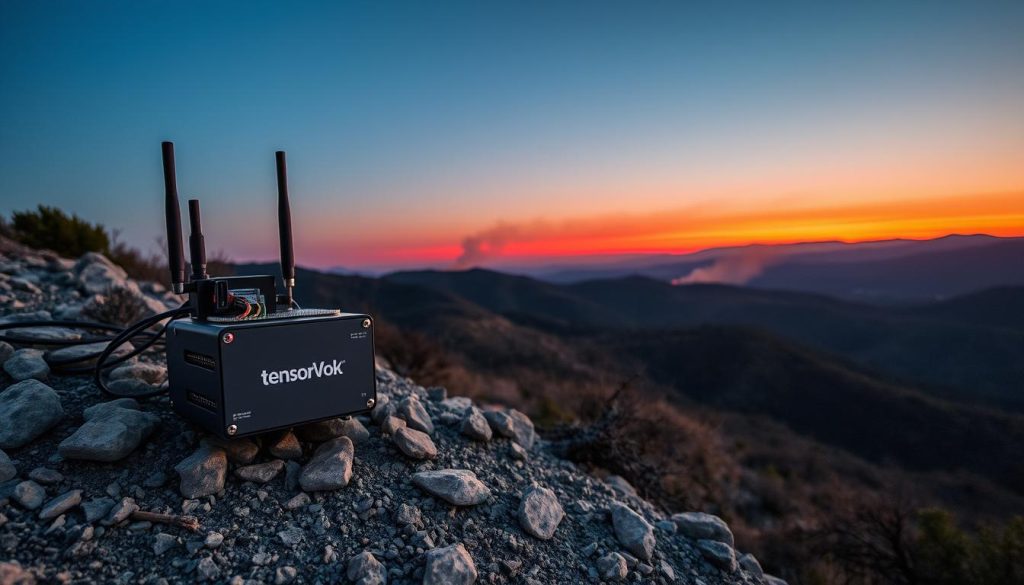
Managing Power Consumption in Off-Grid Locations
Power management is often the most critical factor for systems operating in isolated regions. Your hardware must use high-efficiency solar arrays and deep-cycle battery storage. Optimizing your software to enter low-power sleep modes when no activity is detected can significantly extend the operational life of your equipment.
To maintain consistent performance, consider these essential power-saving strategies:
- Implement duty-cycling to wake sensors only at specific intervals.
- Use hardware components designed for low-wattage operation.
- Deploy energy-aware scheduling to prioritize critical tasks during peak sunlight hours.
Overcoming Connectivity Limitations in Remote Areas
Remote locations often lack reliable cellular or satellite coverage. This is where edge computing becomes a game-changer. By processing data locally, your system reduces the need for high-bandwidth transmissions. This allows for autonomous detection without constant cloud connectivity.
Your systems should store alerts locally and transmit only high-priority metadata when a connection is available. This ensures your autonomous detection capabilities remain active even during network outages. By prioritizing local processing, you minimize reliance on external links. This ensures your edge devices provide immediate, actionable insights regardless of the environment.
Conclusion
We need to protect nature by using new, smart ways to fight fires. You can now use special wildfire smoke detection tools. These tools work right on the edge hardware.
These tools change how we watch for dangers in real time. They use both visual data and environmental info. This makes them better at finding threats and less likely to send out false warnings.
Machine learning is getting better fast. Soon, your devices will handle different weather and forest types better. You are important in making this happen by using these tools now.
Using these tools helps keep nature safe for the future. Try them out on your devices to make your monitoring network stronger. Share what you learn to help others fight fires better.