
Why Upgrade Existing CCTV with AI in Singapore?
Building owners across Singapore are under increasing pressure to improve workplace safety, comply with Work Safety and Health (WSH) regulations, and meet MOM audit requirements — all without the cost and disruption of replacing legacy CCTV systems.
That’s where TensorVok AI Video Analytics comes in. It enables a full AI upgrade of your existing CCTV infrastructure — no camera replacement required. By retrofitting your current IP or analog cameras via RTSP streams, you unlock real-time AI-driven safety monitoring at a fraction of the cost and time of a full system overhaul.
Prerequisites for a Seamless AI Upgrade
- Your existing cameras support RTSP streaming (most modern IP cameras do).
- A stable network connection between cameras and the processing unit.
- Access to camera credentials and network configuration details.
- Basic IT access (e.g., admin rights on local servers or edge devices).
- Clear safety objectives: PPE compliance, restricted zone enforcement, fire/smoke detection, crowd monitoring, or distracted activity alerts.
Step-by-Step: How to Upgrade Your Existing CCTV with AI
- Assess Your Current System
Check if your cameras output RTSP streams. Most Hikvision, Dahua, Axis, and Bosch models do. If unsure, consult your vendor or use a tool like VLC to test stream access. - Install TensorVok Edge Processor
Deploy a TensorVok AI Video Analytics edge device (e.g., TensorVok Box) at your site. This runs locally, ensuring data stays within your premises — critical for PDPA and data sovereignty compliance. - Connect Cameras via RTSP
Input your camera’s RTSP URL into the TensorVok dashboard. The system automatically detects and configures the feed. No re-wiring or new cabling needed. - Configure AI Detection Rules
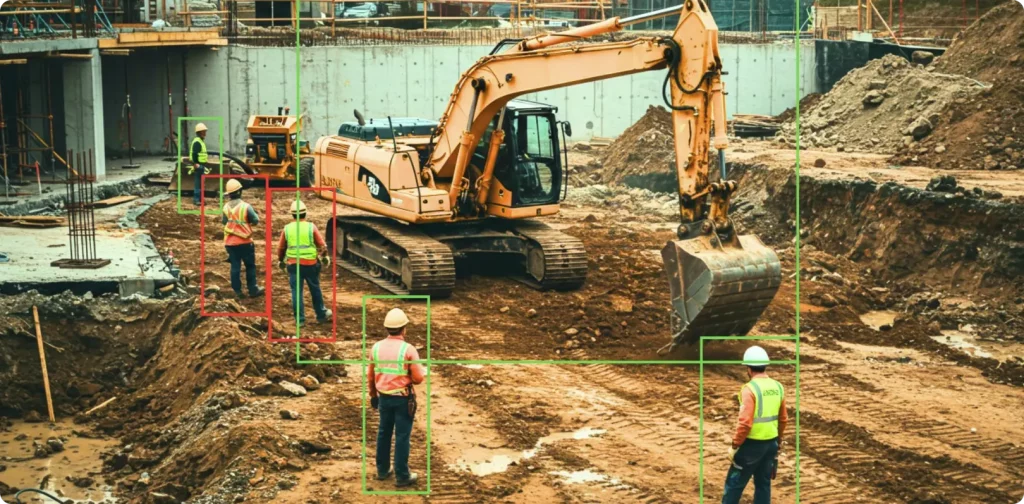
Select from pre-trained models: PPE detection (hard hats, vests), restricted zone intrusion, fire/smoke detection, crowding alerts, and distracted activity (e.g., phone use in high-risk zones). - Calibrate for Singapore Compliance
Enable WSH/MOM audit-ready reporting. TensorVok AI Video Analytics is calibrated to Singapore’s safety standards, generating logs that align with MOM inspection criteria. - Test & Validate
Run a 48-hour trial with real-world scenarios (e.g., worker entering a restricted area). Adjust sensitivity settings using the intuitive dashboard. - Go Live & Monitor
Once validated, activate real-time alerts via email, SMS, or integration with your BMS/SCADA system. All video and analytics remain on-site — no cloud upload.
Common Pitfalls to Avoid
- Poor RTSP Configuration: Ensure camera streams are accessible and not blocked by firewall rules. Use static IPs where possible.
- Overloading the Edge Device: Don’t connect more than 16 cameras per TensorVok Box unless using multi-node clustering. Check device specs before scaling.
- Ignoring Calibration: Default AI models may miss subtle risks. Calibrate for your site’s layout and workflow — especially for PPE detection in low-light areas.
- Skipping Audit Trail Setup: Always enable logging and timestamped event records. These are essential for MOM audits and incident investigations.
How TensorVok AI Video Analytics Solves Key Challenges
Unlike generic AI CCTV solutions that require cloud processing and new hardware, TensorVok AI Video Analytics is built for Singapore’s unique regulatory and operational landscape:
- Works with Existing Cameras: Retrofit any RTSP-enabled camera — no need to replace old systems. Save up to 70% on capital costs.
- Edge Processing = Data Sovereignty: All AI analysis happens locally. Video never leaves your site — fully compliant with PDPA and Singapore’s data residency laws.
- Real-Time Alerts for Critical Risks: Detects fire/smoke, PPE non-compliance, unauthorized access, and crowd density instantly — reducing incident response time.
- MOM & WSH Audit-Ready: Automatically generates structured reports with timestamps, camera IDs, and event types — ready for submission during inspections.
- U.S.-Grade Algorithms, Local Support: Powered by BrightVox LLC’s advanced AI models, delivered and supported in Singapore by Huafa Solutions — ensuring reliability and responsiveness.
- White-Label & OEM Options: Security integrators and SIs can embed TensorVok AI Video Analytics into their own platforms — ideal for reselling or custom deployments.
- Deploy in Days, Not Months: From assessment to live deployment, most sites go live within 5–7 business days.
Frequently Asked Questions (FAQ)
Can I use TensorVok AI Video Analytics with my existing analog CCTV cameras?
Yes — as long as your analog cameras are connected to an NVR or DVR that outputs RTSP streams. Many modern hybrid systems support this. If not, consider upgrading to an IP converter box. TensorVok AI Video Analytics does not require new cameras.
Is my video data stored in the cloud?
No. TensorVok AI Video Analytics uses edge processing — all video and AI analysis occur locally on-site. This ensures full compliance with Singapore’s PDPA and data sovereignty requirements. You retain complete control over your footage.
How quickly can I deploy TensorVok AI Video Analytics?
Most installations are completed in 5–7 business days. After confirming camera compatibility and network access, the TensorVok team guides you through setup. No lengthy procurement cycles or complex integrations.
Does TensorVok AI Video Analytics work with MOM’s WSH audit requirements?
Yes. TensorVok AI Video Analytics is specifically calibrated for Singapore’s WSH and MOM compliance standards. It generates detailed, timestamped reports on safety incidents — including PPE violations, restricted zone breaches, and crowd events — which are directly usable during audits.
Can I integrate TensorVok with my existing building management system (BMS)?
Yes. TensorVok supports API integrations with BMS, SCADA, and alarm systems. You can trigger automated responses — such as turning off machinery when a worker enters a danger zone — based on AI detections.
Do I need technical staff to manage it?
Not necessarily. The TensorVok dashboard is intuitive and requires minimal training. However, for large-scale deployments, we offer onboarding and ongoing support through Huafa Solutions, our local delivery partner in Singapore.
Are the AI algorithms updated regularly?
Yes. TensorVok AI Video Analytics receives regular updates from BrightVox LLC, the U.S.-based AI engine provider. New detection models (e.g., for new PPE types or emerging hazards) are rolled out quarterly, ensuring your system stays ahead of evolving risks.
Can I use TensorVok AI Video Analytics for white-label solutions?
Yes. We offer white-label and OEM licensing for security integrators, system integrators (SIs), and vendors. You can brand the platform as your own while leveraging TensorVok’s proven AI engine and local support in Singapore.