
Keeping your team safe is a big responsibility. Industrial safety compliance is more than just following rules. It’s a promise to keep workers safe and sound at home. At TensorVok, we know the right hardware is key to this promise.
Choosing the right AIoT technology in 2026 is tough. You need power and reliability to keep systems running when it counts. Whether you’re looking at NVIDIA Jetson and Rockchip in AI video analytics, your choice shapes your future.
We aim to make this choice easier. By comparing NVIDIA Jetson vs Rockchip, we help you create systems that are both safe and efficient. Let us help you build a safer, more efficient workplace.
Key Takeaways
- Prioritize hardware that meets both current safety standards and future scalability needs.
- Understand the specific performance trade-offs between leading edge computing platforms.
- Ensure your chosen technology supports real-time, high-precision threat detection.
- Balance the total cost of ownership with the long-term benefits of robust safety systems.
- Leverage expert guidance to navigate the evolving landscape of industrial edge hardware.
The Landscape of NVIDIA Jetson and Rockchip in AI video analytics
In 2026, the gap between high-performance edge AI platforms is huge for industrial safety. Success in projects now depends on more than just speed or TOPS numbers. It’s about operational reliability and handling complex, multi-sensor tasks in real-time.
Evolution of Edge AI Hardware
The industry has moved beyond generic, off-the-shelf boards. Today’s edge AI hardware is made for tough industrial settings. It must handle extreme temperatures, vibrations, and power changes while staying up all the time.
Now, hardware makers focus on long-term stability over quick updates. This means systems stay safe for years after they’re set up. Picking the right platform is a big decision for protecting workers.
Market Positioning in 2026
The market for edge computing platforms has grown into clear levels, each for different business needs. Top solutions offer special boosts for complex neural networks. Mid-range options aim for efficient, local processing.
Whether you need lots of power for many cameras or low power for distant sensors, there’s a tool for every need. We think precision and reliability are key in 2026. By choosing the right edge computing platforms, companies can make AI work in real life, saving lives.
Architectural Differences and Processing Capabilities
The “sense, think, act” loop shows how chip architecture impacts intelligence at the edge. For those building embedded AI systems, choosing between NVIDIA and Rockchip is key. It changes how data is processed and understood in real-time.
The chip you pick sets the limit for AI model complexity. Whether you need lots of power or efficient use, knowing these basics is crucial for industrial automation success.
NVIDIA Ampere and Blackwell Architectures
NVIDIA leads with its massive parallel processing. The Ampere and Blackwell architectures handle dense neural networks well. They provide the speed needed for complex tasks like computer vision.
These chips are top for tasks needing precise inference. They use Tensor Cores to speed up matrix multiplication, key for deep learning.
- High-Performance Computing: Great for multi-stream video analytics.
- Scalability: Easy to grow from small to large projects.
- Advanced Features: Supports transformer models and generative AI.
Rockchip NPU Efficiency and Scaling
Rockchip focuses on balance in embedded AI systems. Their NPUs offer high performance for low power, perfect for tight spots.
In industrial automation, Rockchip is great for deploying specific models. They might not beat NVIDIA in raw performance but are better for steady, reliable work without overheating.
| Feature | NVIDIA (Ampere/Blackwell) | Rockchip (NPU) |
|---|---|---|
| Primary Focus | Raw Throughput | Efficiency/Cost |
| Architecture | Parallel GPU/Tensor | Dedicated NPU |
| Best Use Case | Complex AI/Multi-stream | Edge/Battery-powered |
Choosing depends on your project needs. For high model complexity, NVIDIA is the best. For efficient use in a network of sensors, Rockchip is a cost-effective choice.
Software Ecosystems and Developer Support
The quality of development tools is key when choosing between NVIDIA and Rockchip. For embedded AI systems, the software stack greatly affects your project’s speed and reliability. It’s as important as picking the right silicon for your industrial project.
CUDA and the NVIDIA JetPack Advantage
NVIDIA’s JetPack SDK offers a smooth experience for high-performance edge AI. It gives developers easy access to CUDA, making it easy to use massive parallel processing. The platform is known for its consistency, helping your code go from prototype to production without a hitch.
For those working on embedded vision systems, JetPack’s library support is unmatched. It provides quick access to pre-trained models and optimized containers, speeding up your project’s launch. This lets your team focus on critical tasks, not just setting up drivers.
Rockchip SDKs and Open-Source Integration
Rockchip takes a more hands-on, customizable approach. Their SDKs are built on open-source contributions, which is great for projects on a tight budget. While it might take more effort to learn, you get unparalleled control over your hardware.
This open-source method allows for unique optimizations that closed systems might not offer. With the RKNN toolkit, developers can fine-tune their deployment for specific hardware needs. This is perfect for companies that value long-term maintenance and hardware transparency in their AIoT projects.
| Feature | NVIDIA JetPack | Rockchip SDK |
|---|---|---|
| Primary Strength | Ease of Use | Flexibility |
| Development Speed | Very Fast | Moderate |
| Community Support | Enterprise-Grade | Open-Source/Community |
| Customization Level | Standardized | High |
Power Efficiency and Thermal Management
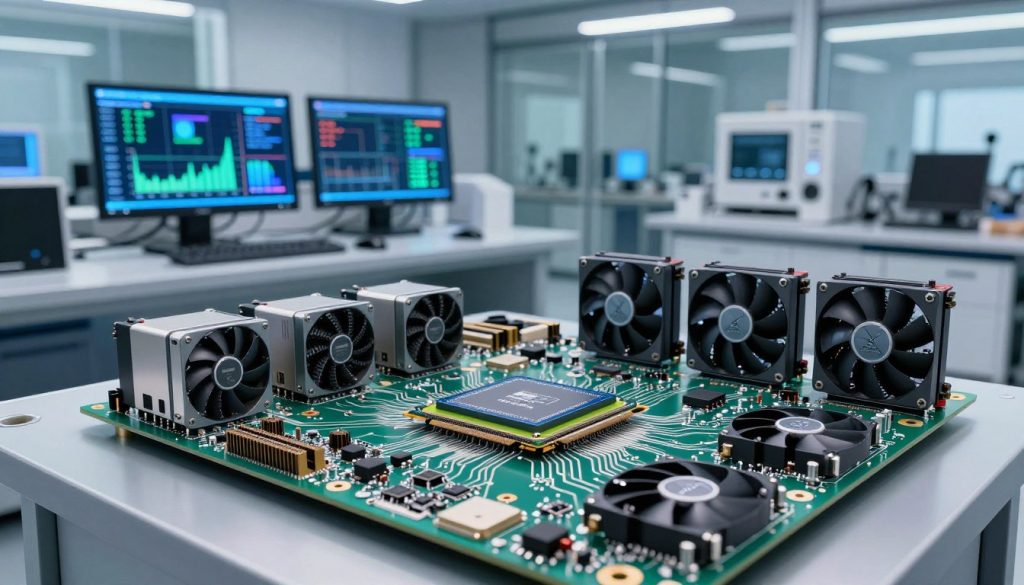
At TensorVok, we know that managing heat is key for top AI performance. In sealed industrial spaces, keeping cool is crucial for system longevity.
We focus on using power wisely to keep safety systems working in hot spots. This careful management stops hardware damage and keeps AI models safe.
Optimizing NVIDIA Jetson for Battery-Powered Analytics
NVIDIA Jetson modules pack a lot of power but need smart settings for battery use. We adjust their speed to cut down heat and keep safety checks running.
Our TensorVok special methods help save energy while keeping AI fast. This lets our clients use batteries longer in places with no power.
Rockchip Performance-per-Watt Metrics
Rockchip chips are known for being energy-smart in embedded uses. They’re made for certain AI tasks with less power than GPUs.
For projects focused on saving energy, these chips are a great choice. TensorVok picks them for places needing little heat and long battery life.
| Platform | Power Efficiency | Thermal Profile | Best Use Case |
|---|---|---|---|
| NVIDIA Jetson | High (Adjustable) | Requires Active Cooling | Complex Multi-Stream AI |
| Rockchip | Excellent (Native) | Passive Cooling Capable | Low-Power Edge Sensors |
| TensorVok Custom | Optimized | Balanced | Industrial Safety |
AI Model Compatibility and Deployment Pipelines
When moving from a prototype to a live environment, your inference pipeline’s efficiency is key. Successful AI model deployment depends on understanding your hardware’s handling of quantized data. We focus on these workflows to keep your safety systems running smoothly.
TensorRT Optimization for Jetson
NVIDIA’s TensorRT engine offers a sophisticated path for developers. It’s crucial for maximizing real-time inference on Jetson modules. By optimizing neural networks for specific GPUs, you can cut down on complex model overhead.
Precision is everything in industrial safety. TensorRT helps convert models into efficient formats. This ensures your safety apps run fast, even under heavy loads.
RKNN Toolkit and Model Conversion Workflows
The RKNN Toolkit is key for Rockchip projects. It streamlines model conversion from TensorFlow or PyTorch to NPU-optimized formats. It’s a balanced approach for deploying reliable AI without complexity.
Quantizing models to 8-bit integers is crucial for embedded chips. This workflow is great for scaling cost-effective, high-precision monitoring solutions. Following these steps keeps your deployment stable and responsive.
Cost Analysis and Scalability for Enterprise Projects
Choosing the right hardware for your AI model deployment is more than just the initial cost. It’s about looking at the whole life of your systems. This ensures they are financially sound in the long run. We look at both the upfront cost and the ongoing expenses of maintenance and integration.

Total Cost of Ownership for NVIDIA Solutions
NVIDIA platforms are a big investment but offer great value. Their strong software ecosystem helps your team work faster and save on engineering costs. This efficiency is key for big industrial projects.
The initial cost is higher, but the long-term ROI is worth it. This is due to several factors:
- Reduced time-to-market thanks to mature tools.
- Wide community support that cuts down on troubleshooting time.
- High performance that means you won’t need to upgrade hardware early.
Budget-Friendly Deployment with Rockchip
For those looking to save money, Rockchip is a good choice. It’s perfect for AIoT white-label solutions that need a lower starting point. Using these chips can save a lot of money without losing important features.
Rockchip is great for projects that need to grow fast and cheaply. It lets your business stay competitive while keeping costs down. Here are some budget-friendly strategies:
- Choose modular designs for easy upgrades later.
- Focus on software-defined features to make your units last longer.
- Use open-source frameworks to avoid high licensing fees.
The choice between NVIDIA and Rockchip depends on your needs and plans. We guide our partners to match their technical and financial goals for lasting success.
Video Analytics Performance in Real-World Scenarios
Industrial automation needs more than just speed. It requires reliable intelligence in every frame. When we use hardware in real settings, the difference between theory and AI video analytics performance is key. We must see how these systems do in complex, real-world environments.
High-Throughput Multi-Stream Processing
Handling many camera feeds at once is crucial for embedded vision systems. Whether it’s a big warehouse or a fast assembly line, the system must handle data streams well. High-performance edge AI needs good memory and parallel processing for this.
NVIDIA Jetson modules often do well here because of their unified memory. This lets the CPU and GPU share data smoothly. Rockchip platforms, on the other hand, have dedicated NPU cores for high throughput with specific models. The right choice depends on your needs for flexibility or specialized tasks.
Latency Requirements for Safety and Compliance
In places where workers are near heavy machinery, industrial safety compliance is essential. Every delay could be a risk. We look for systems that can react quickly to prevent accidents.
Professional-grade systems need predictable latency. We stress test to make sure the hardware responds well even when busy. The table below shows how these platforms compare for safety tasks.
| Metric | NVIDIA Jetson (High-End) | Rockchip (NPU-Optimized) | Safety Impact |
|---|---|---|---|
| Multi-Stream Capacity | High (4-8+ Streams) | Moderate (2-4 Streams) | Coverage Density |
| Inference Latency | Ultra-Low ( | Low (15-30ms) | Reaction Speed |
| System Reliability | Enterprise Grade | Industrial Grade | Uptime Assurance |
Your choice should match your facility’s safety standards. By testing your embedded vision systems in real traffic, you protect your workers and keep operations running smoothly.
Hardware Reliability and Industrial Longevity
When your operations run 24/7, the hardware you choose must be built to last. We know that industrial longevity is key for systems that can’t afford downtime. Whether it’s a factory floor or a remote monitoring station, your hardware needs to last.
Reliability is more than just power; it’s about steady performance under stress. For Embedded AI systems, this means handling extreme temperatures, constant vibration, and power changes. We focus on solutions that promise long-term stability.
NVIDIA Jetson Industrial Grade Specifications
The NVIDIA Jetson industrial modules are made for the toughest environments. They have extended temperature ranges and can handle shock well, perfect for heavy-duty Industrial automation. They’re built to last for years without losing performance.
These modules go through tough testing to meet strict safety standards. By picking industrial-grade hardware, your Embedded vision systems stay up and running in harsh conditions. This durability is key for protecting your investment and keeping safety standards.
Rockchip Reliability in Embedded Environments
Rockchip platforms are known for their stability in various embedded uses. They offer a cost-effective alternative without losing reliability for standard industrial tasks. Many integrators rely on these chips for their consistent performance.
When using Embedded AI systems, Rockchip strikes a balance between efficiency and endurance. Their hardware is great for places where keeping things cool is important but uptime is crucial. We see these solutions excel in stable, long-term use.
In the end, your choice depends on your specific needs. Whether you go for NVIDIA’s rugged power or Rockchip’s reliable efficiency, focus on long-term performance. Choosing the right hardware is the first step in protecting your infrastructure.
Selecting the Right Platform for Your Specific Use Case
Finding the right edge computing platforms is complex. It’s about understanding your project’s needs and goals. This way, your Edge AI hardware will meet your expectations.
When to Choose NVIDIA Jetson
Choose NVIDIA Jetson for high-performance real-time inference. It’s great for handling many video streams at once. It’s perfect for complex neural networks needing lots of power.
The NVIDIA Jetson vs Rockchip debate often focuses on software depth. If you need CUDA-accelerated libraries, Jetson is better. It’s best for big, precise projects.
When to Choose Rockchip
Rockchip is best for cost-effective scalability. It’s efficient and great for devices needing to save power. It’s perfect for projects focused on efficiency, not just power.
Rockchip is good for budget-conscious projects. It uses the RKNN toolkit for reliable results. This keeps costs low while meeting industrial safety compliance.
Always check if your chosen platform meets your safety needs before production. The right hardware is key for safety and efficiency. It protects workers and keeps operations running smoothly.
Conclusion
Choosing the right hardware is key to building a safe and compliant AI system. Your decision between NVIDIA Jetson and Rockchip affects your site’s long-term success.
Whether you need NVIDIA’s power or Rockchip’s cost-effectiveness depends on your goals. TensorVok is here to support you with top-notch AIoT technology for tough environments.
It’s important to test your hardware with real-world data. This ensures your AI system meets your industry’s high standards. Testing helps you scale your system effectively.
Making a smart choice today keeps your workers safe and your systems leading in safety. Contact our team at https://tensorvok.com/ to see how we can help integrate these tools into your setup.