
I’ve spent years in industrial facilities, feeling the weight of keeping a team safe. Every second is critical in a crisis. True safety is not just about having gear; it is about having the right intelligence.
In this tutorial, I’ll show you how to update your safety plans. We’ll use Computer Vision in Hazardous Zones and AIoT. This will turn old systems into smart, proactive ones. It’s a big step towards better risk management.
I want to help you stay ahead of dangers, not just react to them. With these tools, your HazMat response will get better. Your facility will be safer for everyone. Let’s make your HazMat response strategy stronger with AIoT.
Key Takeaways of Computer Vision in Hazardous Zones
- Transition from reactive safety measures to proactive, data-driven monitoring.
- Understand how to integrate smart sensors into existing facility infrastructure.
- Learn to deploy visual intelligence to detect threats in real-time.
- Reduce human error by automating critical safety alerts.
- Improve overall operational efficiency while protecting your most valuable assets.
The Strategic Shift Toward Intelligent HazMat Operations
Modern industrial safety needs a big change in how we handle hazardous materials. Moving to smart operations is key for companies that want to stay ahead. This shift helps us prevent dangers before they happen.
Defining the AIoT and Computer Vision Synergy
The power of change comes from combining AIoT and computer vision. Sensors gather data, and computer vision understands what it sees. Together, they give us a clear picture of our surroundings.
This team-up creates a strong safety system. AIoT finds oddities, and computer vision checks if they’re real. This way, we make sure our decisions are based on solid data and clear images.
Why Traditional HazMat Protocols Require Digital Transformation
Manual checks at hazardous waste sites often miss important details. Old ways can’t keep up with PPE compliance. Also, breaking OSHA 29 CFR 1910.120 rules can hurt a company a lot.
Going digital fixes these problems. It keeps an eye on PPE compliance all the time. This protects workers and keeps sites safe from new rules.
| Feature | Manual Inspection | Intelligent System |
|---|---|---|
| Monitoring Frequency | Periodic/Scheduled | Continuous/Real-time |
| Data Accuracy | Subjective/Human-based | Objective/Sensor-driven |
| Response Time | Delayed | Instantaneous |
| Regulatory Risk | High Liability | Minimized Exposure |
Assessing Infrastructure Requirements for Computer Vision in Hazardous Zones
Using old sensors in dangerous places is risky. They only sound alarms after a chemical leak detection has happened. To keep your place safe, switch to Computer Vision in Hazardous Zones. It spots dangers before they get worse.

Selecting Intrinsically Safe Hardware and Sensors
When I make safety systems, I choose gear that meets strict safety rules like ATEX or IECEx. These tools are made to stop sparks in explosive areas. You need cameras and sensors that give clear data without being a risk.
Using sensor fusion helps mix visual data with chemical readings. This way, your system works well even when things change. You get a full picture of what’s happening, not just one sensor’s view.
Establishing Low-Latency Connectivity in Remote Environments
Remote sites often have trouble with internet. But, you need data fast for quick action. I suggest using private 5G or fast mesh networks. This keeps your devices and the control center connected well.
The table below shows how old systems and new AI ones differ:
| Feature | Legacy Sensors | AI-Integrated Systems |
|---|---|---|
| Response Time | Delayed (Post-Event) | Real-Time (Proactive) |
| Data Depth | Single-Point Metrics | Multi-Layered Sensor Fusion |
| Hazard Detection | Reactive Alarms | Visual Pattern Recognition |
| Operational Scope | Limited/Isolated | Facility-Wide Connectivity |
Investing in strong infrastructure is key. It’s not just about watching. It’s about making a resilient ecosystem that finds risks fast. This is the base of a smart safety plan.
Deploying Edge Computing for Real-Time Threat Detection
When seconds count, waiting for cloud processing is not an option in dangerous zones. I use edge computing to analyze visual data right where it’s captured. This ensures sub-second latency for immediate safety actions.

Processing Visual Data Locally to Minimize Response Time
In complex hazardous waste sites, network bandwidth is often unreliable or unavailable during emergencies. Edge computing moves intelligence close to the source. This way, we don’t need to send big video files to a server.
High-performance models like YOLOv8 and YOLOv11 analyze 2K and 4K visuals continuously. They spot safety risks, like PPE violations, right when they happen. This proactive approach is key to keeping a safe environment.
Configuring NVIDIA Jetson Modules for Field Deployment
I use NVIDIA Jetson modules for their high performance in real-time threat detection. These small, efficient units are made for tough conditions. I set them up to run inference directly at the source, easing the load on infrastructure.
The table below shows why edge-based hardware is better for high-risk industrial settings:
| Feature | Cloud Processing | Edge Computing |
|---|---|---|
| Latency | High (Variable) | Ultra-Low (Sub-second) |
| Bandwidth Usage | Extremely High | Minimal |
| Reliability | Dependent on Network | Autonomous |
| Security | Data in Transit | Data Stays Local |
By using these modules, I make my safety protocols strong and scalable. This setup lets me quickly set up systems across hazardous waste sites without changing existing networks.
Integrating AIoT Sensor Networks with Visual Analytics
I think the future of safety is combining visual analytics with AIoT sensor networks. This mix breaks down old barriers between watching and measuring the environment. It creates a stronger safety net for dangerous industrial areas.
This blend helps us act before problems happen. When systems talk well, we get info fast. This is key for safety teams.

Synchronizing Gas Detection Data with Video Feeds
To spot threats fast, I use a Go-based core gateway. It checks for dangers in just a blink. This way, data moves smoothly without delays.
I link gas levels to live video. This gives operators clear, quick info. When a sensor goes off, the right camera shows up right away.
Creating Unified Dashboards for Incident Commanders
I aim to give commanders one clear view of the place. With sensor fusion, I mix different data into one story. This makes tough choices easier.
This single dashboard is key for spotting leaks and handling emergencies. Commanders don’t have to switch screens. All important info is in one easy-to-use place.
| Feature | Traditional Systems | Integrated AIoT Platform |
|---|---|---|
| Data Latency | Seconds to Minutes | Microseconds |
| Visual Context | Manual Correlation | Automated Overlay |
| Response Speed | Delayed | Immediate |
| System Reliability | Isolated Nodes | Unified Gateway |
Training Computer Vision Models for Chemical and Radiological Identification
Modern industrial safety relies on high-quality data for effective hazard detection. To use Computer Vision in Hazardous Zones well, you need more than just basic algorithms. It’s important to create special datasets that show the unique signs of toxic chemicals and radiological materials.

Curating Datasets for Hazardous Material Labeling
The base of any good detection system is its training data. I suggest using AI with optoelectronic platforms for low-latency classification of toxic chemicals. These tools help process information quickly, so teams can act fast.
When you label your data, make sure it’s done right. Every image should have accurate tags about the chemical and its environment. This careful work helps avoid mistakes and keeps your system reliable in dangerous places.
Implementing Transfer Learning for Specific Industrial Risks
Building a model from scratch is not always needed. Using transfer learning, you can adjust pre-trained models for your site’s PPE compliance needs. This method saves time and keeps accuracy high for your safety rules.
Transfer learning is great for checking things like respirator use or full-body chemical suits. It’s fast and flexible, which is key for keeping safety up in changing industrial settings. Here’s how different training methods affect your work.
| Training Strategy | Data Requirement | Implementation Speed | PPE compliance Accuracy |
|---|---|---|---|
| From Scratch | Extremely High | Slow | High (Custom) |
| Transfer Learning | Moderate | Fast | Very High |
| Pre-trained Baseline | Low | Immediate | Moderate |
Establishing Automated Alerting and Response Protocols
Manual intervention is a risk in today’s fast-paced world. The best HazMat response systems automate from detection to mitigation. This ensures incidents are contained before they become disasters.

Configuring Threshold-Based Triggers for Emergency Shutdowns
Set up precise triggers as your first defense. When sensors detect a leak or pressure spike, the system should shut down immediately. This includes closing valves and isolating zones without human confirmation.
This proactive approach is key to predictive maintenance. It prevents failures by monitoring equipment in real-time. Automated safety protocols offer many benefits:
- Reduced Response Time: Eliminates delay between detection and action.
- Human Safety: Keeps people safe from high-risk zones during leaks.
- Containment Efficiency: Stops hazardous materials flow at the source.
“Automation in hazardous environments is not just about efficiency; it is about creating a safety net that operates faster than human reflexes ever could.”
Automating Drone Deployment for Reconnaissance Missions
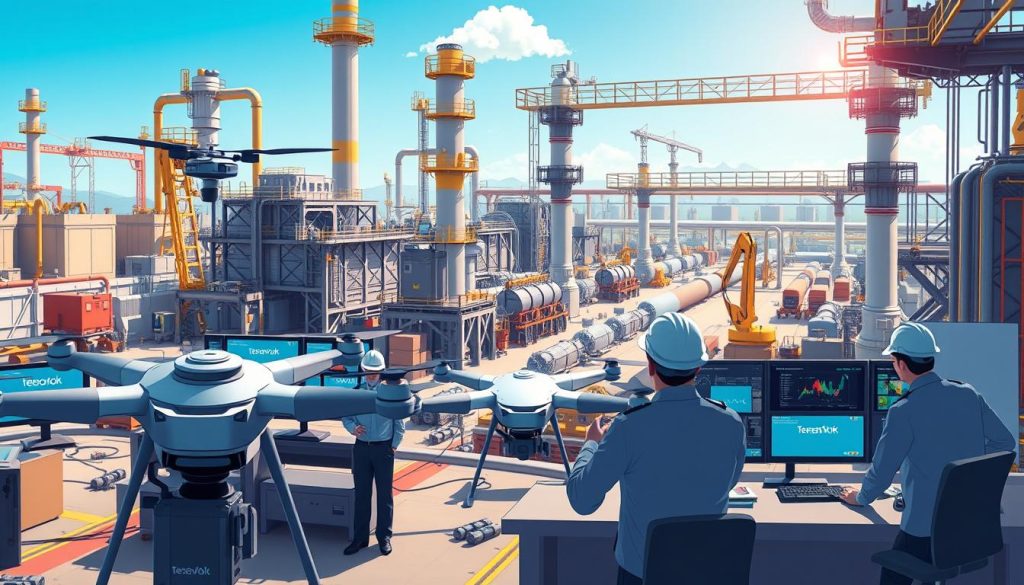
After an incident, gathering intelligence is key. I suggest using autonomous drones for real-time visuals. These drones can safely enter dangerous areas, providing clear views of the situation.
Integrating automated alerting with drone reconnaissance gives a huge advantage. You can assess spills or fires safely. The table below shows how this technology changes emergency management.
| Feature | Manual Response | Automated Response |
|---|---|---|
| Detection Speed | Minutes to Hours | Milliseconds |
| Valve Shutdown | Manual/Delayed | Instant/Triggered |
| Reconnaissance | Human Entry | Autonomous Drone |
| Risk Level | High | Low |
Combining predictive maintenance with automated response makes a resilient facility. Investing in these technologies is responsible for any hazardous material handler. By focusing on automated alerting, you protect your assets, environment, and people.
Overcoming Implementation Challenges in High-Risk Environments
The biggest challenges in high-risk areas often deal with signal reliability and data safety. The idea of smart monitoring is great, but industrial sites can be tough. Getting past these challenges is key to keeping your place safe and running smoothly.

Mitigating Signal Interference and Environmental Obstructions
Hazardous zones have lots of metal and chemicals that mess with wireless signals. To keep a strong connection, using edge computing to handle data locally is best. This way, you avoid delays from environmental issues.
Also, setting up a strong mesh network helps get past physical barriers. By placing nodes smartly, your automated alerting systems keep working, even when signals are blocked. This is key for keeping an eye on things during emergencies.
Ensuring Cybersecurity for Connected HazMat Systems
Keeping your digital setup safe is as important as handling physical dangers. I focus on cybersecurity to stop unauthorized access to critical safety info. A secure network is essential for any good monitoring system.
Following OSHA 29 CFR 1910.120 means your safety plans must be secure and right. With end-to-end encryption, your automated alerting systems are safe from hackers. This cybersecurity makes sure your edge computing gear is trusted by your team.
Your dedication to these standards shows you’re serious about OSHA 29 CFR 1910.120. I think being proactive is the best way to protect your people and your place’s future.
Scaling Intelligent Response Systems Across Industrial Facilities
My method for industrial facility scaling is about making a plan that works everywhere. When you grow beyond one place, managing smart safety systems gets harder. You need to make sure your HazMat response is the same everywhere, no matter where your plants are.
Standardizing Deployment Across Multiple Sites
Having a standard setup is key for big, reliable systems. Use a “golden image” for your hardware and software to avoid problems. This way, your teams can keep safety enforcement the same in every place.
To do this, follow these main steps for each new site:
- Centralized Configuration: Use tools to update all devices at once.
- Unified Hardware Specs: Choose safe sensors to make sure they work together.
- Standardized Training: Make a training plan that works for everyone, so you don’t have to retrain staff.
Developing Long-Term Maintenance and Update Cycles
Keeping your AI models up to date is as important as setting them up. Over time, things like weather can make sensors less accurate. So, it’s good to have a plan for regular checks.
Also, strong cybersecurity is part of keeping your systems safe. As new threats come up, you need to update your systems to stay protected. Here’s a plan for keeping your smart systems in top shape.
| Activity | Frequency | Primary Goal |
|---|---|---|
| Model Retraining | Quarterly | Improve detection accuracy |
| Security Audits | Bi-Annually | Strengthen cybersecurity |
| Hardware Calibration | Annually | Ensure HazMat response precision |
By sticking to these plans, you keep your systems and people safe. Consistency is the key for success in dangerous places. When you focus on these upkeep tasks, your safety systems are always ready for anything.
Conclusion
I think using AIoT and computer vision is a big step forward in safety. These tools help protect people and the environment from dangers in work places.
I want to help you follow OSHA 29 CFR 1910.120 rules better. These tools make it easier to handle risky situations.
It’s important to use predictive maintenance. This helps avoid big problems before they start. It keeps your work running smoothly.
To grow your industrial site safely, use these digital tools everywhere. Start using them now to make your workplace safer for everyone.
Get in touch with your safety team to start using these smart tools. They will make your work safer and more reliable.