
Construction sites in Hong Kong present distinct safety challenges. The dense urban environment and complex projects demand advanced technological solutions.
Over recent years, the need for automated monitoring, for example Vest Detection [ A form of AI video analytics ] has become critical. It is essential for maintaining the highest standards of worker protection.
Our guide provides a comprehensive look at using artificial intelligence to mitigate risks. We focus on how these systems enhance overall safety protocols in the construction sector.
We analyze the current landscape of safety monitoring. Modern tools are designed to meet the specific operational needs of Hong Kong’s industry.
- Hong Kong Smart City Blueprint 2.0
- Smart Site Safety System (SSSS) Hub
- Development Bureau’s Technical Circular
- Innovation and Technology Fund
By adopting these best practices, project managers can create more secure sites. This proactive approach significantly reduces accident likelihood and ensures regulatory compliance.
Key Takeaways of AI Vest Detection
- Hong Kong’s construction environments have unique safety and logistical challenges.
- Advanced Vest Detection is now a fundamental requirement for modern site security.
- Artificial intelligence systems can dramatically improve safety protocols and worker protection.
- Implementing intelligent monitoring helps project managers reduce the risk of accidents.
- A proactive approach to safety enhances overall site security and ensures compliance with regulations.
Introduction: Ensuring Construction Site Safety in Hong Kong
The bustling activity of Hong Kong’s construction industry creates a complex safety landscape that demands proactive management. As Barnali Sharma, a content contributor, emphasizes, automated monitoring of personal protective equipment is essential for minimizing risks in hazardous zones.
The Importance of PPE Compliance on Sites
Industrial locations are often filled with large, noisy machinery. Strict PPE rules for every individual are non-negotiable.
Check out Tensorvok PPE detection solution.
This fundamental requirement has evolved significantly over recent years. Ensuring everyone wears high-visibility attire is a core part of modern protocols.
Addressing Safety Risks in a Busy Environment
We recognize that Hong Kong’s projects are particularly dense. Automated monitoring of safety gear becomes a vital component of site management.
When a worker is missing this attire, they may not be seen by equipment operators. This creates severe hazards on busy locations.
Our approach focuses on how this gear acts as a primary defense mechanism. It prevents injuries through continuous, non-intrusive oversight.
By prioritizing PPE compliance, we help organizations maintain a safer environment. This protects every team member from potential dangers during daily operations.
Overview of AI Technologies in Construction Safety
At the core of next-generation site security are sophisticated AI-driven systems designed for proactive hazard prevention. These technologies transform raw video data into actionable safety intelligence.
This shift is fundamental for managing complex construction environments effectively.
Computer Vision and Video Analytics Fundamentals
Computer vision forms the backbone of modern automated safety applications. It allows systems to interpret visual data much like the human eye, but with greater consistency.
Research over the years has refined these techniques. A 2017 study, for example, utilized color analysis for worker identification.
Today’s models analyze multiple features like motion and shape. This enables reliable object classification even in difficult lighting.
Leveraging Intelligent Surveillance Systems
We deploy intelligent surveillance systems that provide continuous, real-time monitoring. These platforms are built on advanced AI video analytics.
Their core capabilities directly address site security needs:
- Automated identification of safety protocol violations
- Consistent operation across various lighting and weather conditions
- Seamless integration with other site management applications
This automation ensures compliance is maintained without constant manual oversight. The result is a safer, more efficient construction zone for all personnel.
Understanding Vest Detection Systems
Our approach transforms standard video feeds into a powerful tool for enforcing safety protocols. These systems provide a detailed understanding of compliance across the entire construction zone without constant manual checks.
How AI Recognizes Safety Vest Patterns
We utilize advanced AI models trained over recent years. They analyze specific color and reflective patterns on safety gear. This is the basics of AI vest detection.
This allows the software to distinguish between different personnel roles or departments. It enhances overall site management and security.
Integration with Existing Monitoring Hardware
Modern jobsites often have extensive networks of IP cameras. Our analytics software of vest detection integrates directly with this existing hardware.
This seamless connection simplifies deployment. It allows for a highly customizable approach to safety oversight.
Specific zones can be monitored to ensure gear is always worn. Continuous monitoring of personnel does not disrupt daily workflow.
This integration turns current surveillance into a proactive safety net. It is a critical object for maintaining a secure environment for every worker.
Implementing Advanced Object Detection Models
Implementing high-performance AI models requires a meticulous approach to training and system customization. We focus on frameworks that deliver reliable, real-time identification of safety gear and personnel.
Deploying YOLOv2 and Deep Learning Frameworks
Our core deployment uses the YOLOv2 architecture. This model operates with a 416-pixel input size for high-performance object identification.
The implementation leverages Keras with a TensorFlow backend. It supports versatile backends like MobileNet for efficient processing.
Over recent years, deep learning frameworks have empowered us to build a robust detector. This system accurately identifies a person equipped with critical safety items.
Training, Validation, and Customization Techniques
A rigorous training process is fundamental. We organize our datasets into separate folders for images and their corresponding annotations.
This structure teaches the network to predict bounding boxes with high accuracy. We continuously monitor the loss during training to optimize the model’s performance.
Our code allows for the customization of anchor boxes. This is essential for precise identification in diverse construction environments.
By cycling through the training set multiple times, we significantly improve the detector’s precision. This ensures every worker is accounted for in real time.
Leveraging Datasets for Precise Detection
Accurate identification of safety gear begins with meticulously prepared datasets. The quality of our training data directly determines the model‘s real-world performance.
We build a robust foundation for deep learning by focusing on two core areas.
Data Collection and Annotation Best Practices
We have refined our process over recent years. Our team gathers diverse images from real construction environments.
These pictures often feature a person wearing a safety helmet [ see ai helmet detection ] or other protective items. Variety in lighting and angles is crucial.
We use the LabelImg tool to create precise annotations in Pascal VOC format. This step defines bounding boxes around each critical object.
Our dataset organization includes an automatic 80/20 split. This creates a dedicated validation set to test generalization.
Optimizing Loss Functions and Network Performance
The network‘s learning is guided by carefully tuned loss functions. Optimizing these mathematical components is key.
It improves the precision of predicted boxes for gear like a helmet or vest. Our code allows for customization to fit specific site layouts.
We continuously evaluate the detector against the held-out validation set. This rigorous check ensures reliable safety monitoring before deployment.
This data-driven approach is fundamental for achieving high-fidelity vest detection in Hong Kong’s dynamic sites.
Customizing vest Detection Solutions for Hong Kong Sites
Generic detection models often fail in Hong Kong’s complex environments. Every site layout presents distinct challenges that demand a tailored approach.
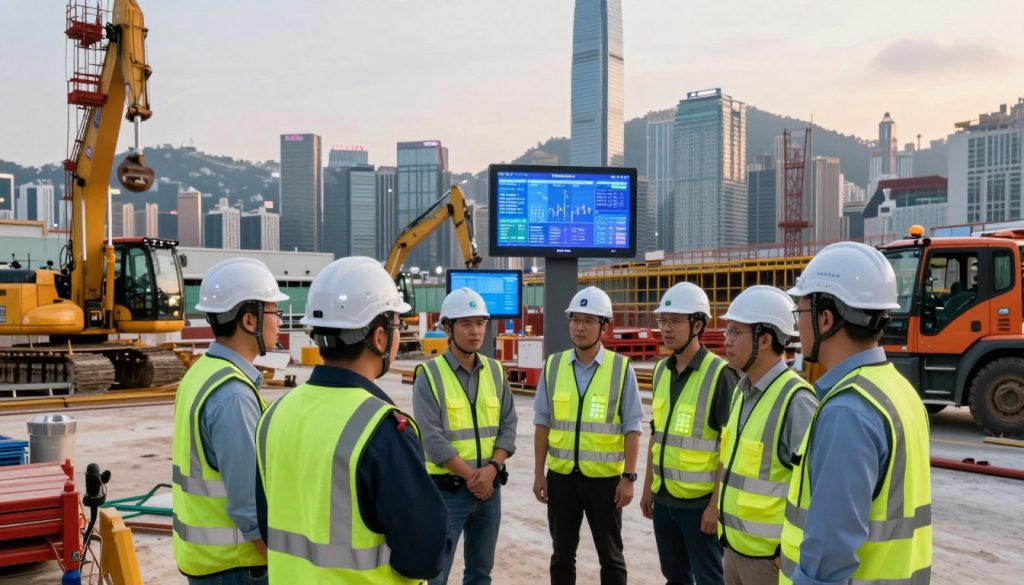
We adapt our system’s parameters to the unique footprint of each location. Critical zones like loading docks or entry gates have specific safety rules that must be enforced.
Adapting Parameters for Unique Construction Layouts
Over the past few years, we have learned that a one-size-fits-all model is ineffective. Customizing for specific site usage is key to maintaining high safety standards.
Our approach involves training the network to recognize gear in various environments. We use diverse images from real construction sites to improve learning.
By adjusting bounding boxes and loss thresholds, we ensure consistent detector performance. This technical fine-tuning is validated against a dedicated validation set.
We provide content-rich configurations for seamless integration of our code. This ensures safety helmet and vest detection aligns perfectly with each project’s operational needs.
Enhancing Safety with Real-Time Monitoring Systems
Real-time monitoring systems represent a transformative leap in proactive construction site safety management. Over the past few years, the demand for instant hazard identification has become a standard. We bridge this gap with our intelligent platform.
Our systems process live video streams to identify risks as they emerge. This allows for an immediate response, fundamentally changing site security.
Automated Alerts and Immediate Response Mechanisms
We utilize deep learning models trained on a diverse dataset. These models analyze images to pinpoint a missing helmet or other protective gear.
The core code integrates seamlessly into your existing camera network. This creates a continuous monitoring solution without manual oversight.
When the detection system identifies a non-compliance, an alert is sent instantly. Supervisors can then act within seconds, not hours.
“The ability to intervene in real-time is the difference between a near-miss and a reportable incident.”
We validate each deployment against a rigorous validation set. This ensures high precision and minimizes false alarms, optimizing the loss function for your specific site.
| Feature | Manual Oversight | Automated Vest Detection Monitoring System |
|---|---|---|
| Response Time to Non-Compliance | Minutes to hours | Seconds |
| Site Coverage | Limited by personnel | 24/7, entire zone |
| Consistency of Enforcement | Variable, prone to human error | High, rule-based |
| Integration with Existing Networks | Minimal | Seamless via API |
This proactive approach ensures every worker is protected. It turns standard surveillance into a powerful object for prevention.
Performance Metrics, Results, and Industry Benchmarks
To ensure our technology delivers on its promise, we rigorously measure its performance against established industry benchmarks. Transparent metrics provide the confidence our clients need.
These results validate the system’s capability to enhance construction site safety for every worker.

Interpreting mAP, Loss, and Precision Metrics
We evaluate our model using the mean Average Precision (mAP) metric. Our YOLOv2 implementation achieves a score of 42.1 on the COCO validation set.
This serves as a key benchmark for object identification performance. Over recent years, we have refined our model by continuously analyzing loss and precision during the training cycle.
This process ensures our detector performs reliably on complex site images.
Comparative Analysis with Industry Standards
Our results demonstrate accurate identification of a person or a safety helmet. We constantly compare these outcomes against recognized industry standards.
The data from our validation set allows us to refine the code and network. This ensures reliable vest detection and sets a high benchmark for operational safety.
By maintaining these rigorous comparisons, we guarantee our systems provide optimal protection.
Conclusion
We firmly believe that the future of construction safety in Hong Kong is intelligent, proactive, and continuously learning. The AI models we’ve discussed transform passive observation into active protection.
This technology ensures every worker wearing a helmet or vest is accounted for. It creates a more secure environment through constant oversight.
Adopting these systems is a decisive step toward modernizing your safety protocols. It moves your site beyond basic compliance to genuine, data-driven care for personnel.
Rigorous training on a diverse data set allows for precise detection. We encourage all project leaders to embrace this proactive approach.
It builds a foundation for a worksite where everyone returns home safely.